Below the Fold: Model Behaviour

August 18, 2026

Below the Fold is the monthly newsletter from Cognito’s Australian team based in Sydney, an independent PR and communications agency specialising in financial services and technology.

Most advertising loses 95% of its impact within a couple of weeks of running. The best of it, the emotional and expensive television work, might hold on for a month or two. This is according to the IPA, Binet and Field, and the Ehrenberg-Bass Institute, and underpins how ROI is measured and discussed within the broader industry.

Thinkerbell’s Dan Monheit used these insights in Mumbrella in late July to highlight that the “half-life” of earned media has now changed. He says that once the LLMs have decided, on the strength of a trusted source, that your product is the best in its category, that conclusion holds until something of equal authority displaces it, which could be years away, if it ever happens.

Readers of last year’s October edition will remember the Muck Rack research I quoted: 95% of AI citations come from non-paid media, 89% from earned. Monheit doubles down on the endurance of those highly cited pieces.

So – if good coverage compounds, then so does bad coverage. I’ve done a full dissection of this under ‘Kudos and Catastrophes’ below.

Also in this edition: Scott’s read on the narratives moving Australian headlines, client hits we’re proud of, a journalist insight we found interesting, and a note on the News Bargaining Incentive, which arrives in parliament this session looking quite different to the draft I wrote about in April.

As always, feel free to get in touch if any of the points included caught your eye, or if there’s something you’d like to see discussed in next month’s edition.

Until next time,

Jonathan Buxeda,

Director, Cognito ANZ

Narratives Down Under

As observed by Scott Schuberg, Managing Director, Cognito ANZ

Botch the use of AI in a legal case, and it could land you a record fine or have you banned from practising. This still happens. Lawyers were penalised a total of around US$110,000 in Oregan in April this year for fabricated citations, and lawyers were fined and barred from appearing for two years in a district in Mississippi in June this year for either using fabricated citations or signing off on submissions that included them.

These are great news stories for lawyers with hard-earned experience, who seek out leading authorities and dig through public and commercial databases to scrape together case law that actually exists.

But what happens when AI gets it right?

Casual university lecturer Gregory Baker, who openly used AI to represent himself in a workplace legal dispute, as covered by David Marin-Guzman at the AFR, used multiple AI agents to not just build his case, but to cross-check the veracity of it too. His knowledge about industrial relations law at the time he began, in his own words, were “None whatsoever.”

He won.

In addition to clocking up a win, he also helped create a landmark decision that, no doubt, AI agents like his will cite in the future for those wishing to take advantage of a legal loophole that has allowed him to transition from a casual to a permanent part-time position at Macquarie University that—as discovered by his AI agent research in the first place—will allow him to apply for research grants.

It’s all well and good to celebrate the David vs. Goliath shape of this story, but the Fair Work Commission has the unenviable task of now expecting even more legal arguments like Gregory’s to be thrown at them, while already “drowning in AI-written claims from self-represented litigants,” as characterised by Marin-Guzman. Knowing how much the likes of vexatious litigants can drag on legal systems, I can’t imagine the pressure the system is now under as it faces armies of AI-armed amateur legal sleuths.

Taking a step back, and please bear with me, as this may read as tangential and self-indulgent, I began doing some light research on the history of Athens recently. Cognito’s two-yearly ‘Cognicon’ global meet-up will be there in mid-September, and I’ve never been. One of the slivers of history I spent more than a few minutes on was the evolution of law from oral custom to written form, beginning with Draco’s and Solon’s attempts to see law serve the public and not just the aristocrats.

I don’t think it’s a dramatic stretch to say that, for perhaps $20-$100 per month and with the case study above in mind, AI is presenting the public with the most significant democratic step-change in the application of law that it has seen in two and a half thousand years.

Legal practitioners don’t have a monopoly on the challenges professional services employees face due to the advent of AI; we’re all in the same boat, and anyone claiming to have all the answers is either naïve or trying to sell you something. And professional services execs are broadly in the same business – we help businesses grow by maximising opportunities and mitigating threats.

Regardless of the people or technology we have, using all the resources available as catalysts for growth remains the ultimate measure of value.

*AI’s use in this article was limited to finding significant global cases where remedies included harsh penalties for lawyers.

Client Spotlight

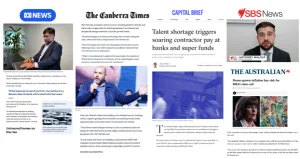
We usually talk about our coverage one story at a time, but this month we wanted to zoom out and showcase the breadth of our Tier 1 work. We continue to secure strong coverage across financial and trade media, but these are the stories we’re particularly proud to put in the spotlight. Across some of our clients, we secured coverage in ABC News, The Australian, SBS News, AAP, The Canberra Times and Capital Brief, spanning mainstream, business and broadcast media.

The stories themselves cover some of the biggest issues facing Australian consumers and businesses, from rising insurance costs driven by climate risk and young investors taking on more risk, to the skills shortage and regulatory changes driving demand for independent talent, as well as the outlook for inflation and interest rates. Each story took a different route to the news agenda, but all started with a strong, timely insight that could be translated into something meaningful for a wider audience.

Behind the coverage is close collaboration with our clients. We work together to find the strongest angle, identify what Australians will care about and determine what our clients can add to the conversation. It is this combination of our financial services expertise, strong storytelling and understanding of what mainstream journalists need that allows us to consistently turn complex topics into stories that cut through.

Kudos and Catastrophes

On 28 July, Vinyl Group CEO Josh Simons published a piece on the front page of Mediaweek, outlining his objections to the way a rival trade publication has been covering Vinyl.

Some context for readers outside Australia. Vinyl Group is an ASX-listed business that has spent three years buying up media brands: Rolling Stone Australia, Time Out Australia, Pedestrian Group and Mediaweek itself. Mediaweek is one of the key trade titles covering the marketing and communications industry in Australia. The other of note is Mumbrella, which has reported on Vinyl’s acquisitions, share price and AI editorial plans with …

Josh works through eighteen months of coverage, itemises the adjectives applied to the company and its strategy, disputes a series of figures on cash receipts and audience reach, and confirms a complaint to the Australian Press Council. The Council declined to take the complaint on because Mumbrella is no longer a constituent body. Mumbrella’s Tim Burrowes has since responded.

Mumbrella’s readership is several thousand media and marketers, most of whom form their own views.

The kicker here is that the coverage has been indexed and summarised by the LLMs, resulting in a characterisation of the company that is less than positive. “Repetition does not make a false proposition true,” he writes, noting that repetition does make a claim more likely to be absorbed by the retrieval systems, and by people who will never open an ASX filing.

The mechanism he is describing is essentially what Thinkerbell’s Dan Monheit spoke about in his piece on the enduring nature of information referenced by LLMs within trusted sources.

Traditional guidance on hostile trade coverage used to be simple: small audience, short shelf life, responding only feeds it, sit tight. That advice depended entirely on the declining curve of awareness of a piece over time – as spoken by a colleague, “don’t fan the flames”. Take this decay away and that advice changes, especially if the scrutiny is coming from a widely cited ‘reputable’ source for the industry.

Monheit’s piece makes the point that authority signals read by the LLMs are weighted by how hard they are to fake.

For example, if I wrote that, “Jonathan Buxeda is a highly skilled and experienced communicator for the financial services industry”, this may count for very little when it comes to informing my online/AI presence (still worth a shot, though eh!)

An independent, credible publication saying the same thing counts for much more. Several thousand words of rebuttal published on a masthead the subject owns is, in those terms, a weaker instrument.

With all of this context in mind, the treatment should be more obvious – albeit nothing particularly new for PR professionals. Independent coverage, strong messaging, independent data sets, spokespeople in well-read publications, etc.

Displacing a high-authority signal takes another high-authority signal, which simply reaffirms what we’ve been telling our clients for several months now. PR is no longer just PR – good PR is good GEO, and now, vice versa.

Looking Ahead: Feeding the beast

On 3 July, Nine and Microsoft announced an agreement letting Copilot reference the text of Nine’s mastheads, including material beyond the paywalled preview. That covers the AFR, the Herald, The Age, Brisbane Times and WAToday.

News Corp got there in 2024 with OpenAI, in a global deal reported at more than US$250m over five years, which brought The Australian, the Telegraph, the Herald Sun, the Courier Mail and news.com.au into ChatGPT.

Two years ago, a story in the AFR reached the AFR’s readership, and as far as the LLMs were concerned, it more or less stopped at the paywall. They could see the headline and the preview. The reporting itself, the part with the quotes, the argument (and our spokespeople), was not available to them. For Nine’s mastheads inside Copilot and News Corp’s inside ChatGPT, that is no longer the case.

So, the premium tier of Australian journalism (where our clients often most want to be in) is becoming machine-readable – essentially changing the practice of GEO, again.

With the News Bargain Initiative in its final stages (essentially encouraging publishers to make deals with the LLMs), the direction of travel is toward more of these deals.

So, while the underlying strategy will not change too much, our targets and the argument of volume vs. quality may very well do.

More to come.

Journalist Insights

Journalists are increasingly using AI tools to search their inboxes for relevant content, commentary and spokespeople, giving well-crafted pitches a much longer shelf life.

We recently saw this play out through our work with our client, Webull. Commentary we pitched back in May around the appointment of the new ASX CEO was resurfaced months later, when a journalist repurposed the forward-looking comments for a story on TMX’s acquisition of Cboe Australia. The story has since been syndicated across multiple publications in the Australian Associated Press network.

It’s a good reminder that pitches can continue generating coverage well beyond the original news cycle. With journalists using AI to surface older material, it’s more important than ever to include press releases and ready-to-use quotes directly in the body of an email, making relevant commentary easier to find and reuse.

And that’s it! Until next month.

Jonathan Buxeda
Director / Australia
Article Link
Below the Fold: Model Behaviour
Read More
Article Link
Cognito and DeepSeer Launch Predictive Intelligence for Financial Services Firms
Read More
Article Link
 Below the Fold: Joe Bogan went there
Read More
Article Link
The Signal Before The Noise
Read More
Article Link
The education alibi: why private markets hasn’t solved its mis-selling problem 
Read More
See how Predictive Intelligence is reshaping communications strategy.