
The space race for AI search dominance is offering brands a window to act. As this nascent practice of generative engine optimisation (GEO) quickly shapes and reshapes its own methodology, requests for strategic communications and media relations advice on how to compete are increasing. This article provides key findings, considerations and solutions for communications professionals operating in the Australian financial services industry.
Important note on article methodology: I used Cognito’s enterprise AI platform, Anthropic Claude, to develop foundational research on quality of AI search results across select industry superannuation brands. I then used ChatGPT, Perplexity and Google AI search to refine the in-platform results specific to those engines. Once I had sufficient research, I wrote this article manually, using observations from the research. Any aggregated data supplied in this article directly from AI has been referenced as such.
Introduction
Many of us will recall seeing our first Google GEO results in AI overviews, which topped both sponsored and organic search results. We knew change was coming, and some brands acted faster than others in the fight to provide large language models (LLMs) with the content that would back answers to prompts, as long-form search strings began to prevail.
As publishers with paywalls rightly took action to protect their intellectual property, other publishers are seeing the advantages of freely exposing content to LLMs. For communications professionals, this has been a hasty paradigm shift. Just as post-GFC quantitative easing rewrote the rulebooks on the fundamentals of economics, post-AI brand profiling needs to honour the tradition of providing high-quality insights to senior journalists behind paywalls, in chorus with more accessible trade media content required to inform those prompting AI for quick solutions to their problems.
Given the $4.5 trillion size of the Australian industry superannuation sector (forecast to grow to $8.1 trillion by 2035) and the task this industry’s brands have in differentiating themselves from one another, I figured this was a good place to start. The broader takeaways from this article also apply across Cognito’s other key sectors of technology, sustainability and professional services.
Context is king
As many of us are finding out, a superficial approach to seeking assistance from AI yields superficial results. Understanding your prospect’s buyer journey, archetypes, idiosyncrasies and goals remains part of your domain, not that of AI. AI will take a great guess at what your potential customers might ask for when researching a solution, but relying on it (as opposed to using it to house and analyse your empirical research) is going to give you a very fast, very incomplete picture of how to compete.
Just like you’ll need to earn your place in results that answer “What is the best industry super fund in Australia” by ranking on performance, you’ll need to show up to multiple stakeholders: prospective investors; government; industry regulators; federal regulators; institutional investors; and the general public for social licence. As such, you can’t just start posting reams of content on your website watch the results roll in. You still need C-Suite profiling, thought leadership and corporate content placed across mainstream media, trade media, owned media, social media and reference websites like Wikipedia.
The GEO suggestions in this article may give you some quick wins as the AI industry develops its approach to quality, but it doesn’t replace the fundamental brand work that will win the hearts and minds of your publics.
GEO scorecard (and the need to look at the whole chessboard)
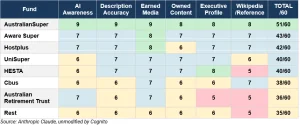
While taking a wholesale approach to GEO research can be reductive, this table does offer a useful snapshot for this industry, in terms of how these brands rank. It does not, however, include the detail and quality of results that a full GEO audit combined with strategic communications advice can offer brands.
Why does AustralianSuper rank first? Many reasons. The brand is distinctive and descriptive – AustralianSuper does what it says on the tin. Its team clearly has a vigilant, multi-channel communications approach: award entries; executive profiling; presence in consultant white papers; investor and analyst relations; references from government entities due to its size; a thorough and up-to-date Wikipedia listing; a tendency to stay away from news containing negative sentiment; high-quality earned coverage; frequency and recency of all corporate communications; and, yes, comprehensive and diverse owned media articles, research reports and executive bios.
You may already be building a picture of why, contrary to popular belief, actual operations and full-suite corporate communications directly impact GEO scores. GEO can’t solve ASIC disciplinary woes. GEO can’t solve your CEO turnover. You can’t game GEO into believing you are more reputable than you are.
So how should comms leads view the GEO publication landscape in Australia?
Notwithstanding everything I’ve said about the operational challenges of building your brand’s GEO score from the ground-up, there are distinct platforms that comms leaders should be targeting to achieve a mix of open-access, high GEO-value publications alongside paywalled-access, high-authority publications.
The full list of 25+ mainstream and trade publications relevant to the Australian industry superannuation sector containing all of the key attributes is available at request by emailing [email protected]. If you’re operating in a different industry, please feel free to get in touch so we can help develop some targets for you.
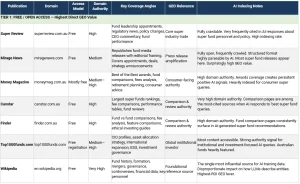
Source: Anthropic Claude, ChatGPT, Perplexity, Google, modified by Cognito
Please click here or email [email protected] to obtain a copy of the full list.
How to structure GEO content to match prompts
It is true that there is a window of opportunity, whereby GEO guardrails are a little loose and real-time data collection is allowing brands to push content into the right places, providing direct answers to GEO prompts. This is likely to evolve quickly.
For now, developing content and offering insights, including thought leadership publications, Q&As/FAQs, sponsored advertorial, earned media quotes/interviews etc. based on relevant prompts is likely to capture the attention of audiences, where as a failure to address these prompts will make brands invisible to that GEO audience.
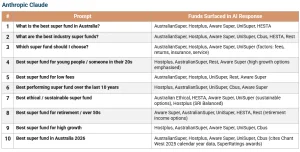
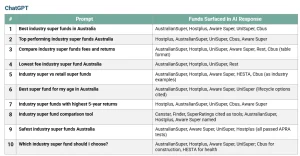
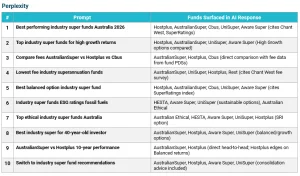
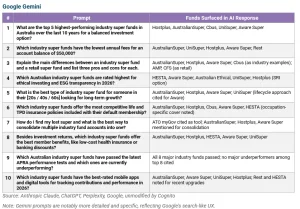
Please see Appendix A for a list of the most commonly used prompts relating to the Australian industry superannuation sector across four prominent AI platforms.
Conclusion
Throughout the ongoing journey of building a great brand, the work done to improve GEO scores should feel organic – like you’ve been asked by the internet to deliver more context to its users, not like you’ve found a way to trick a system to yield results.
While it is true that this process might be a nudge to put your articles in the context of answering questions that are key to your audience, perhaps this is a simple reminder of the need to meet your audience where they are as they research your sector and find the right fit.
Appendix A: Prompt prevalence across AI search
Each AI engine works differently, has different audiences and—specific to Google Gemini—has UX that prompts the users to enter questions in different formats. The table below shows the prompts to keep in mind when developing communications exposed to LLMs.
Scott Schuberg is Managing Director in Australia