It was a slower year for Money20/20.
Money20/20 this year is still at the RAI, Amsterdam’s sprawling centre. Yet it was on a smaller footprint compared to the year before, four halls instead of the six or so that required a large concourse to connect them. This still means hundreds and hundreds of booths, kiosks, three-seater couches only available through prior reservations and an approximately four meter diameter model of the moon suspended from the ceiling. Yet it was somehow still a bit of a step down.
“Were you here yesterday?” multiple people asked me on Wednesday. “It was a ghost town.”
Perhaps it felt slower as I was physically slower as well. A persistent ligament injury on my right ankle prevented running around the hall at top speed. This made me more sedentary but also gave me a greater capacity to observe my surroundings.
Immigration also got the memo: it took nearly three hours for my American passport to clear customs, despite already being registered in the new EES entry system. So did some of the people on site: I spent half an hour in an increasingly aggravated queue after an hour-long photographer’s lunch break had become nearly two. At one point, some of us in line wondered if we’d just be there until the equipment was hauled away, although I did, in the end, get a new photo.
The issues with my gait necessitated intermediary stops. A favourite place to pause was a small, fenced-off area in the middle of a lounge. The tables had chess sets on them and the place was known as the Gambit Den. Did I ever see anyone actually playing chess? No. It must have seemed like a reasonable idea on paper.
Literalism was everywhere this year. Nearly every theme, idea or execution was presented in the most straightforward way possible.
One of the most important stories of the last five years has been the increasing alignment between decentralised and traditional finance. To illustrate this was a giant hanging karat that said “tradfi” with a neighbour several metres to the right that said “defi.” They called it the “Intersection Stage.” Considering the state of international relations, it seemed to me that if they were two nations, tradfi and defi are living quite harmoniously. Working together, more people will have more money that arrives at them with less and less friction. The panels bled into each other, the conversations congealing into a thick paste of buzzwords.
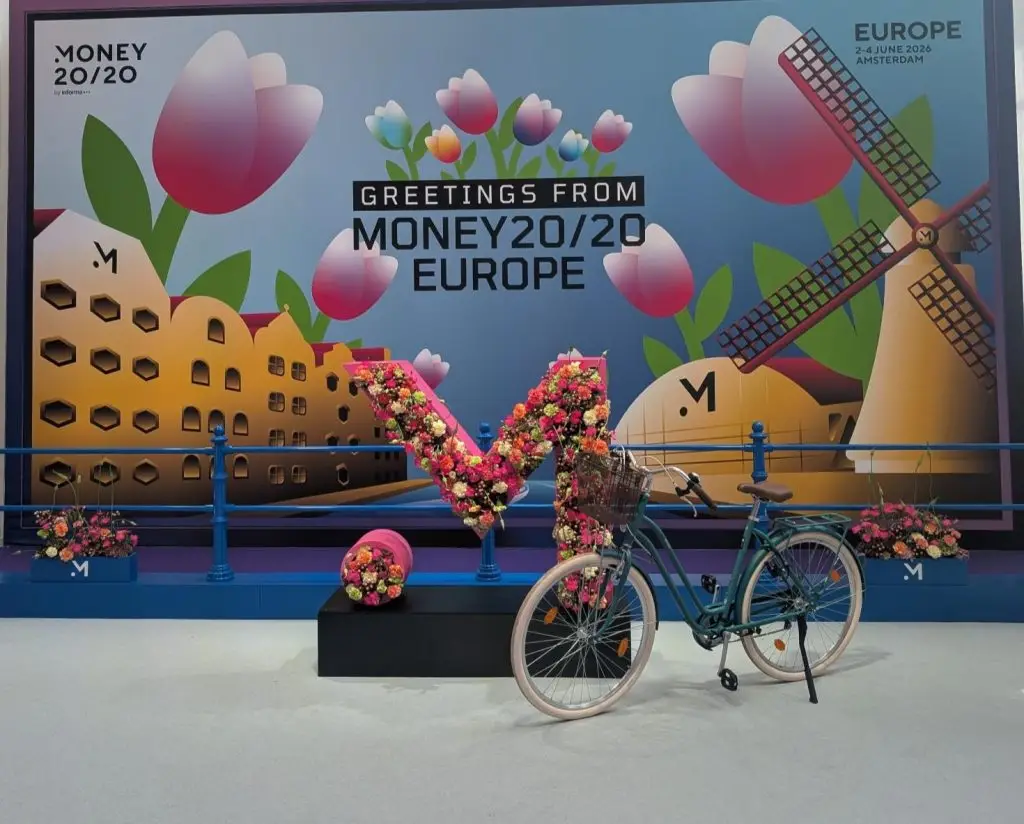
Panels with titles like “Agents Using Stablecoins Are the Future of Payments,” apparently thrown together through some sort of GEO Madlibs generator, didn’t help. Perhaps what’s wrong with that is that it sets an expectation of escalation. The floral-themed entrance was perfectly nice, yes, but I was disappointed it wasn’t on the same scale as the deconstructed pink-and-purple pinwheel from the year prior.
The whole industry, of course, is beholden to this maxim: grow or perish. Continuous momentum is a key ingredient — any sign of stagnation or even deceleration can bring the whole enterprise into question. It doesn’t help that the entire show essentially needs to be renewed annually.
The best conversations were very much in the backrooms. Here, after a few words about how traffic to this part of the exposition hall was below expectations, I heard some blissfully unfiltered tales of deployments that both worked and ones that weren’t quite ready for primetime. Fintech felt risky and passionate here, in ways the official stages seldom articulated.
I enjoy how the show floor can be almost a physical manifestation of the European continent. A Lithuanian salesperson told me that the best place in Vilnius was his private garden on the city’s outskirts. I heard how clustering in Stockholm means that you can still meet your former colleagues for fika at the same coffeeshop. And we went deep on the differing entrepreneurial cultures in Cluj and Bucharest.
There were acquaintances everywhere, their slightly older faces telling animated stories of common names who became rich, lost their jobs or did something scandalous. I imagine this week my interlocutors will provide their own report back in the office: Jon was in good spirits, thinner, greyer and with a bit of a limp. He also spent quite some time ranting about automation in reporting.
Everyone – and every joint – has a limit. On the final day, I was seated (foot elevated) near a stage whose programme ended several hours prior. Someone walked over to me, one of those people who first seems unrecongisable but at the right distance you are thrilled to have run into. We traded experiences, frustrations and observations.
And she leaned in and said how she really felt: “Honestly, I just can’t wait for this conference to be over.”
Jon runs content for Cognito